When painting in acrylics, I highly recommend that you prepare your canvas ahead of your painting session, with enough time in between to allow the prep layer(s) to dry. If you are starting to paint with an unprepared canvas, see the tips below for this situation.
The primary reason I recommend prepping your canvas before starting your painting is due to the fact that acrylic paint shrinks as it dries. If you paint alla prima, i.e. all in one session, when your painting dries, you may end up with lots of little white dots where the white of the canvas is peaking through.
In addition, preparing your canvas first:
- makes it so much easier to get in some lights and darks early on,
- and I think it ultimately makes for a richer look
For preparing your canvas, I recommend one of the following approaches:
#1 Single Layer Prep:
This method is preferred when you only have time for one layer of paint to dry before you plan to start your painting.
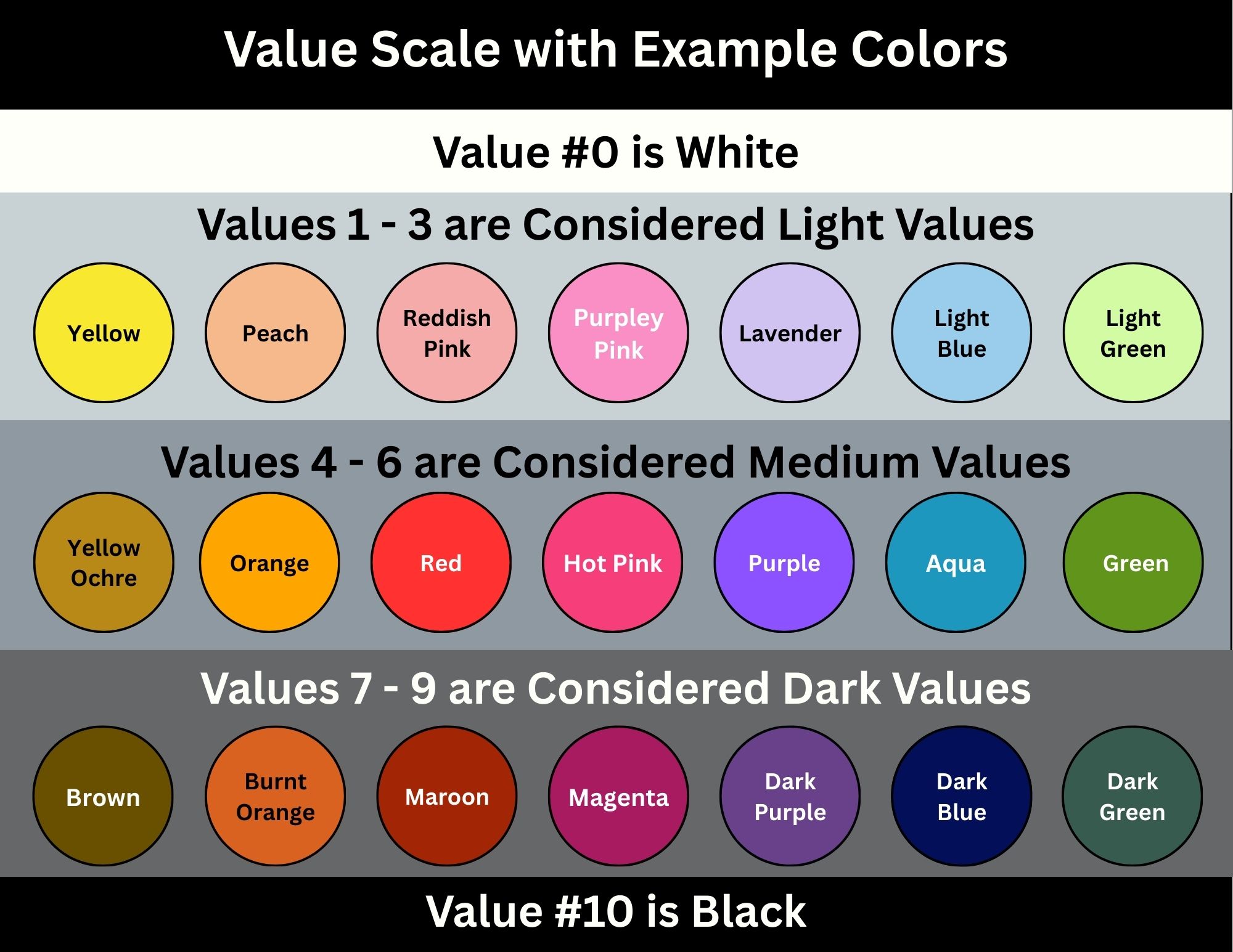
- Choose a medium value color. (See the image below for some examples of colors that are considered to be a medium value.).
- Cover the front of your canvas so that no white is showing, and paint the edges as well. The thickness of the paint is up to you. You can thin your paint with water so it will dry faster, and so it will seep into the texture of your canvas. But, if you want to start with a thicker or textured surface, a thicker coat is fine, as long as you have time for it to dry.
- Let this layer dry completely before starting your painting.
#2 Double Layer Prep:
If you have time before your painting session, I find this method to be the most effective. It is also best for sketching your subject first when you want to use something like charcoal or pencil.
- For the first layer, choose a dark value color, but not black. A color with a value around 7 or 8 would be best. Starting with a dark color allows you to ensure you cover all of the white of your canvas.
- Cover the front so that no white is showing, and paint the edges as well. Once again, you can thin your paint with water and apply a thin wash, or apply it thicker for texture.
- Let this layer dry completely.
- Cover your first layer with a really light value color, but not white. A color with a value around 2 or 3 would be best.
- Let this layer dry completely before starting your painting.
#3 Quick Wash with No Drying Time
If you are ready to paint, and you don't have any preprepared canvases, you can certainly painting on a white canvas if you want. However, I recommend doing at least a quick wash of paint over most or all of your canvas, even if you don't have time to let the wash dry before starting your painting. Most artists use a raw umber or similar for this wash.
An Extra Tip for Painting in Layers
When working wet into wet, as during an alla prima, or "all-in-one" session, it is typically best to start with thin paint and gradually get thicker as you build up layers of paint. If you apply paint thickly in the early layers, it can make it tricky to apply the desired color or value over a different color or value.
A Quick Note on Gesso
I am often asked about using gesso, if it is needed, reasons for using, etc. Most store-bought, pre-stretched canvas has already been primed with gesso. If it is primed with a non-acrylic primer, then it will usually indicate that it has been "oil primed." If it has not been primed, it should be labeled "un-primed", and many artists refer to this as "raw canvas."
Gesso and all primers are used for the following purposes:
- to prime a surface that hasn't been primed
- primer can increase the adhesion of the paint to the surface
- multiple layers of primer can be used to reduce the amount of paint seeping into the canvas
- sanding between multiple layers of dry primer can result in a smoother surface
- primer can be applied thickly for texture
If you are using a pre-primed, store-bought canvas, you do NOT need to add additional gesso or primer. However, some artist will in order to achieve a particular effect. Certain acrylic mediums can be used as well to change how the paint will react.
For More Info:
Please contact Jennifer at Ferris Wheel Arts, an Art Studio for Adult Painting Lessons in Roswell, Georgia.