What is Value?
As it relates to painting, value is the relative darkness or lightness of a color. In the image below, a value scale starting at 0 for white and 10 for black, shows some examples of how various colors might be described in terms of value.
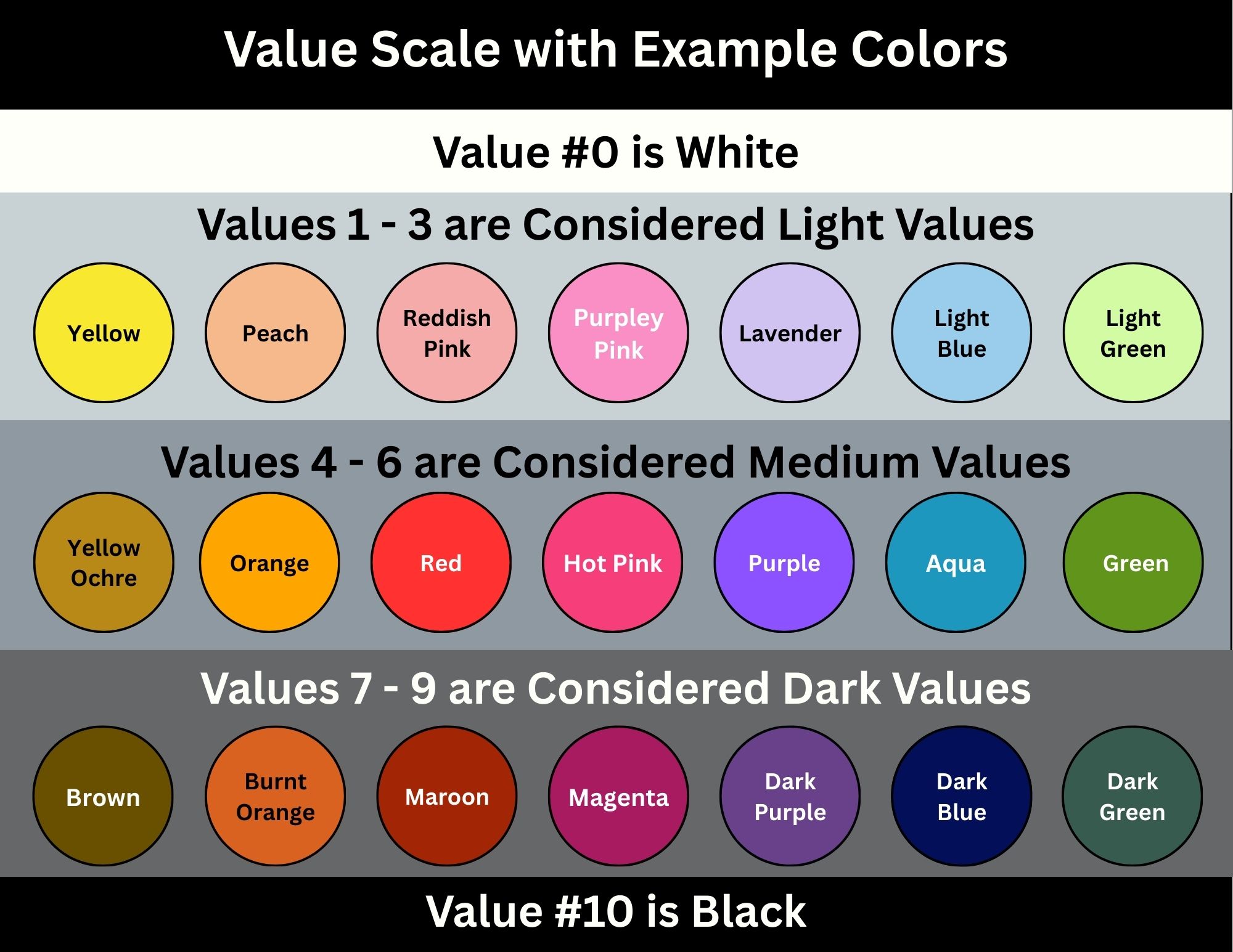
Every painting does NOT need to use the entire value scale from white to black:
- if you want a very light value painting, referred to as a "high-key" painting, maybe you would only use values less than five or six. Since the value of color is a relative property, in this case, values 5 & 6 would be considered a dark values, 3 & 4 would be considered medium values, and 0-2 would be your lightest values.
- Or, for a high-key painting, you could fill the majority of your canvas with values below 4, and then have just a few marks in medium values, or a few marks in a dark value, or both.
- ...(this is a draft post: check back later for more info...)
The Importance of Using a Range of Values
There are examples of famous paintings hanging in museums with as few as just 1 or 2 values, but I would consider those to be the exception, and that in MOST cases, a range of values is preferred. There are a variety of reasons for this, including:
- Shapes are more easily distinguished when they are painted using different values.
- Values give dimension to shapes.
- Values give depth to the entire painting.
- Using two contrasting values is one of the ways to identify your focal point.
- ...(this is a draft post: check back later for more info...)
Conversely, there are reasons why you might choose to use a narrow range of values, including:
- Fewer values reads with less depth/flatter, which is one of many ways to abstract your subject matter.
- To contribute to a particular feeling or story.
- ...(this is a draft post: check back later for more info...)
For More Info:
Please contact Jennifer at Ferris Wheel Arts, an Art Studio for Adult Painting Lessons in Roswell, Georgia.